A one-day working session for cross-functional product and customer-facing teams that want to make real progress on UX strategy without committing to a longer engagement.
Most product companies face the same situation before they articulate it as a UX strategy problem. The backlog keeps growing, every item looks like a good idea, and prioritisation turns into a debate about opinions. Meanwhile, UX debt accumulates — the cost of every decision the team doesn’t quite make. Features ship, numbers move a bit, and the same questions come back around — which problems matter most, whose needs are we actually serving, what does the product need to be in two years.
Underneath those questions sits the same missing piece: the team doesn’t yet have a deep, shared understanding of how customers experience the product today. Without that, the future state is a guess. Without a future state, there’s nothing to prioritise against.
The workshop is designed to lay that foundation in a day. It gathers the right cross-functional group, works through the current experience with whatever evidence the team has, and produces a draft set of UX outcomes the team can act on immediately. Where the evidence is thin, you also leave with a clear picture of the research that should shape the coming months.
Six hours on-site, at your offices or a venue you arrange. Where the team is distributed, the workshop can also run remotely. Two follow-up coaching sessions in the weeks after keep the work alive as the team puts it into practice.
What changes during the workshop
A single day won’t rebuild how your team works — that takes longer. But a well-run day can move a team from stuck to moving, and produce concrete material to carry into the weeks after. By the end of the session, you have:
- A first draft of prioritised UX outcomes, tied to specific improvements in your users’ lives — and to the business impact those improvements create.
- A clear separation between the outcomes the team can defend with evidence and the ones that still rest on assumption — and a plan for turning the second into the first.
- A short, defensible research agenda — what you need to learn next, in roughly what order.
- A basis for prioritisation that everyone in the room can stand behind — product, design, engineering, and customer-facing teams working from the same understanding of what good looks like.
The material is yours from the moment the session ends. Many teams take it and carry on independently. Others use it as the first step into a longer engagement.
Why the workshop exists
The pattern described earlier — a growing backlog, prioritisation-by-opinion, strategic questions that keep recurring, and UX debt accumulating as a consequence — rarely resolves on its own. Teams that recognise the pattern often try to fix it with an internal workshop, and the internal workshop usually disappoints.
The reasons are structural. The people in the room are the same people who have been having the conversation for months, which means the conversation takes on the familiar shape. The facilitator is part of the same organisation and the same politics, which constrains what they can push on. No one in the room has the distance required to challenge assumptions the team has come to take for granted. What typically emerges from these sessions is a tidier account of the same stuck position.
The workshop takes a different route. It brings the right people into the same room for one day — product, design, engineering, and customer-facing leaders together, working with whatever evidence already exists, facilitated by someone outside the organisation. The compression of a single day changes the conversation: a team that has a day behaves differently from a team that has an open-ended series of meetings. The outside facilitator changes the conversation too, because assumptions that have hardened internally can be questioned by someone without a stake in them.
Who this is for
Tech product companies whose teams have started to feel the cost of working tactically, shipping quick fixes without a clear view of where the product is going. They recognise that in a market where everyone can ship quickly, the experience of using a product is what sets it apart. They want to make UX work strategic, but aren’t yet sure how.
The workshop is built for cross-functional groups rather than design teams in isolation: senior leaders from product, design, engineering, and customer-facing teams (support, sales, customer success) should be in the room together. The friction that customer-facing leaders see every day usually sharpens the outcomes considerably.
The workshop fits best when the team has at least one initiative or strategic question to work from, and someone with decision-making authority to convene the room and move the conversation forward. It also fits best when the team is genuinely ready for the answer — including the possibility that the evidence behind some current assumptions is thinner than the decisions that have been made on it.
How it works
The pre-workshop call does the work that makes the day succeed. Together with the internal sponsor, we agree on the initiatives or strategic questions the day will draw on, confirm the participants, and shape the day around what matters most for your team right now. Participants receive a short preparation brief the week before — typically a set of role-specific questions to think through, or material to gather, depending on what the participant brings to the workshop. The brief is light, but it shifts what the team can do on the day.
Existing research isn’t a prerequisite, but it makes the day considerably stronger. Where you have it — journey maps, support data, customer interviews, anything that grounds the conversation in real customers — we use it. Where you don’t, we work with what the team can articulate, and the clarity of that gap becomes part of what the day produces.
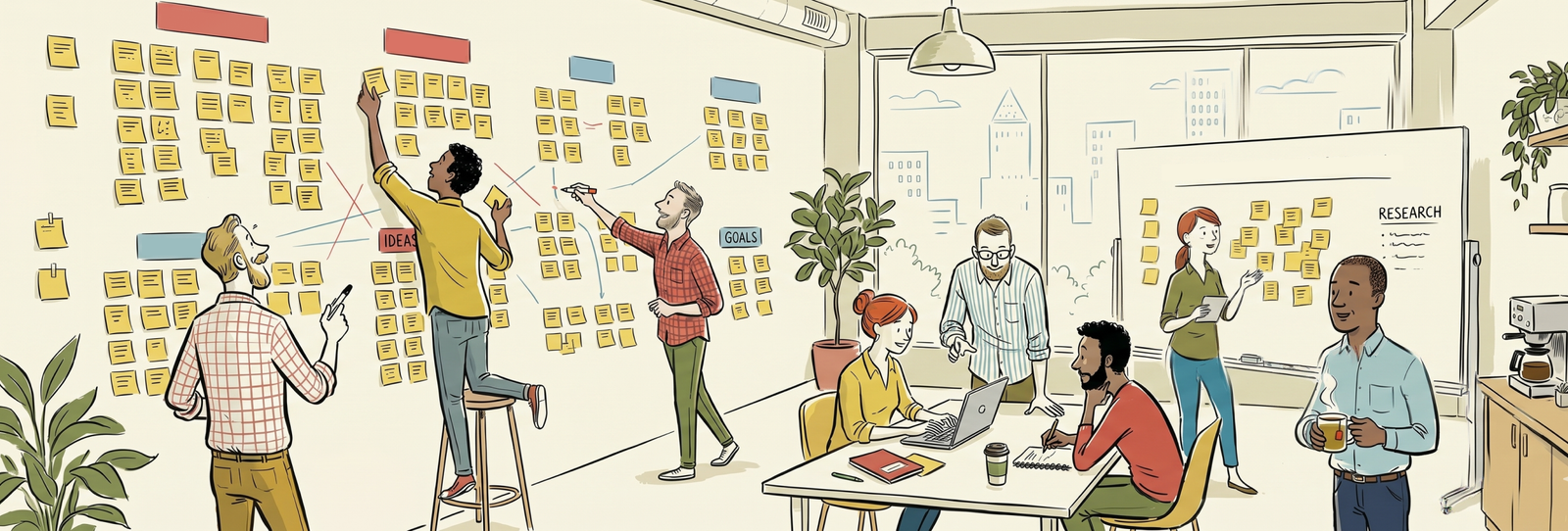
On the day, the work begins with the current experience rather than with strategy. Before the group can agree on outcomes worth committing to, it has to share a picture of what customers go through today, grounded in whatever evidence the team has brought into the room. From there the conversation moves into the outcomes themselves — specific improvements in your users’ experience that the team could commit to — and then into prioritisation. The cross-functional setup of the room is what makes that conversation different. Product, design, engineering, and customer-facing leaders are all working from the same picture of the current experience, which sharpens what the team can agree on as worth pursuing.
The final part of the day separates the goals the group can defend with evidence from the ones that still rest on assumption. The first set becomes a draft the team can act on immediately. The second becomes a research agenda — what the team needs to learn next to turn the assumed goals into evidenced ones. Everything is captured live on the artefacts the team builds in the room, and belongs to the team from the moment the session ends.
Two follow-up coaching sessions in the weeks after the workshop give the team a structured chance to review progress, address what got harder than expected, and refine the outcomes as the work moves into practice. The first session usually happens four to six weeks after the workshop; the second another four to six weeks after that.
Pricing and terms
A fixed engagement fee for the workshop and the two follow-up coaching sessions. For on-site workshops, travel costs are invoiced separately at cost. Additional sessions can be added beyond the included two. Specific figures are covered on an introductory call.
Where the workshop leads into the full UX Strategy Programme within three months, the workshop fee is credited in full against the programme.
I run a limited number of workshops each quarter, and won’t run workshops for companies competing in the same product category within the same quarter.
Who you’d be working with
I’m Kyrylo Slavetski, a UX strategy consultant with twenty years in product design, UX research, and design leadership across a range of product companies. The workshop draws on years of running cross-functional strategic conversations from the inside — as a leader of design and research teams, working alongside product, engineering, and customer-facing colleagues to shape what the team should be working on and why.
I work with a small number of clients at a time, in person on the day itself where possible. Based in the Netherlands, working with clients across Europe and, when the fit is right, further afield.
Frequently asked
How is this different from your UX Strategy Programme?
The Programme is a six-month facilitation engagement that carries a team from first principles to a working system of vision, outcomes, and metrics. The Workshop is a single day focused on one part of that arc: agreeing on a draft set of UX outcomes and the research priorities that follow. It can stand on its own, and it can also serve as the diagnostic first step into the Programme.
Can the workshop replace the Programme?
The day produces clarity that most teams don’t have going in: a narrowed, user-centred view of what to work on, why those things matter for the business, and how to tell whether the work is succeeding. For some teams, that’s exactly the unblock they need. The Workshop doesn’t produce a long-term UX vision, a cascading system of metrics, or the internal rituals that keep strategic work alive over months. Teams that want those outcomes are better served by the Programme from the start.
What if we’re not sure whether the workshop is what we need?
The thirty-minute introductory call is designed to sort that out. We’ll talk about your team, your current situation, and what you’re hoping to get from a workshop. If the workshop is the right fit, we’ll plan it. If a different engagement would serve you better — or if you’re not yet at the point where this kind of session helps — I’ll say so.
Who should be in the room?
Six to twelve people, typically including the Head of Product or equivalent, senior product managers, the Head of Design and senior designers, one or two senior engineers, the senior researcher where you have one, and one or two leaders from customer-facing teams. A room of only product, design, and engineering leaders tends to produce outcomes quietly shaped by existing assumptions about customers, which is exactly what the day is meant to surface and question.
What does our team need to prepare?
Very little. The pre-workshop call surfaces the initiatives or strategic questions the day will work from. Participants receive a short preparation brief the week before — a set of role-specific questions to think through, or material to gather, depending on what each person brings to the workshop. Existing research isn’t a prerequisite, but it makes the day considerably stronger. Where you have it, we use it. Where you don’t, the clarity of that gap becomes part of what the day produces.
Can the workshop be run remotely?
Yes, where the team is distributed and bringing everyone together is impractical. The on-site format produces stronger results when it’s feasible — there’s something about the sustained attention of a physical room that remote sessions can’t fully replicate — but a well-run remote workshop is genuinely valuable, especially when the alternative is no workshop at all.
Can the workshop run as two half-days instead of one full day?
Yes. Two half-days, ideally on consecutive days or within the same week, can work nearly as well as a single day. There’s some loss in the momentum that comes from working through the full arc in one sitting, but where the alternative is no workshop because nobody can clear a full day, two half-days are a real option.
What happens after the workshop?
You leave with a draft of prioritised outcomes and a research agenda, captured on the artefacts the team has built during the day. Two follow-up coaching sessions over the following two months give the team a structured chance to review progress, adjust outcomes as the work moves into practice, and address what got harder than expected. After that, many teams carry on independently. Others use the workshop as the starting point for the UX Strategy Programme — in which case the workshop fee is credited in full against the programme, provided the programme begins within three months.
What about confidentiality and competing clients?
Mutual NDAs as standard. I don’t run workshops for companies competing in the same product category within the same quarter — that includes direct competitors and close adjacents.
How is the workshop priced?
A fixed engagement fee for the workshop and the two follow-up coaching sessions, with additional sessions available beyond that. Specific figures are covered on an introductory call.
Let’s talk
Thirty minutes is usually enough to know whether the workshop is the right starting point. We’ll talk about your team, your current situation, and what you’re hoping to get from a day together. If the workshop is the right fit, we’ll start planning it. If a different engagement would serve you better — or if a workshop isn’t what you need at all — I’ll say so.
Write to me at kslv@kslv.io, or schedule a call directly.